
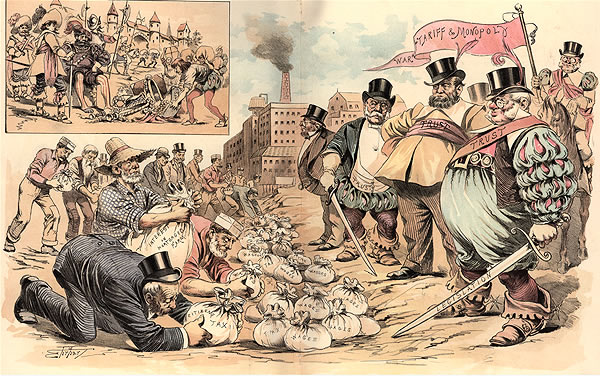
I keep hearing our current whatever-this-is referred to as the Second Gilded Age. It certainly checks all the Gilded Age boxes —
Gaudy exterior over a tawdry reality? Check.
Worship of extremely wealthy people with extremely bad taste? Check.
Widening gap between the wealthiest few and everybody else? Check.
Open corruption, both fiscal and political? Check.
Blaming the poor and shrinking the middle class? Check.
Our index era, Gilded Age Prime, is of course the late 19th century, when the new industrial era was creating a few fortunes on a scale not seen before. Mark Twain and Charles Dudley Warner coined the phrase, a cynical label for the cynical time they lived in. Large-scale industrial capitalism had replaced the artisanal capitalism of the early Republic, businesses were consolidating, and scratching the surface of polite society revealed the law of the jungle.
In 2025, the president may claim we’re entering a new American Golden Age, but no, it’s definitely gilded. A look at the redecoration of the Oval Office will confirm that. (See “bad taste,” above.) The hero-industrialists of the 1880s have been replaced by the tech-bro billionaires. Trump rhapsodizes about the protective tariffs of the 1880s, and seeks to return to that era’s lack of regulation. The corruption — well, I rest my case.
But is this the Second Gilded Age we’re in? Within my own Near Backward, this all seems very familiar. I’m sorry to deploy the stock phrase, but I’m Old Enough to Remember the Reagan era, when many of these things or their analogs were going on. We even called it the Second Gilded Age. So that pushes our Gilded Age back to third place.
In some ways the Reagan Second Gilded Age never ended. Even when Democrats regained the White House, Bill Clinton and Barack Obama internalized many of the “lessons” of the Eighties, assuming that the electorate had turned against more progressive policies. The gap between the richest and the rest has mostly continued to grow, and the luster of tech industries had a series of bubbles and bursts. The erosion of the middle class and the grinding-down of the poor has mostly lasted. A recent anomaly occurred in the first half of the Biden presidency, with policies that could have reversed those trends if they had been allowed to continue. Trump’s second term has quickly snuffed those hopes out.
But heading on into the Far Backward, there’s another contender, I think. The Progressive Era, which had tried to roll back the excesses of the Gilded Age, came to a ragged end with America’s World War One experience; and by the 1920 election, Warren Harding was able to sell the voters on a “return to normalcy” which we know familiarly as the Roaring Twenties. Many of the Progressive business regulations were rolled back or ignored, and the “Captains of Industry” like Henry Ford and Harvey Firestone were national heroes.
I haven’t seen any evidence of people in the 1920s referring to their own time as a Second Gilded Age — but maybe it’s time to bestow that title retroactively. We all know how that boom of the Twenties turned out — Gilded Ages tend to sow the seeds of their own destruction.
So that puts our current Gilded Age in the number four position. None of these Gilded Ages stand up very well to the scrutiny of history, and I have no doubt that the time will come when this one gets its day of judgment.
But have I left any Gilded Ages out? Should we go farther Backward, before the phrase existed? Or was America’s relationship with wealth different before the Civil War?
One response to “How many Gilded Ages does this make?”
-
I’ve been trying to find out when America was great and what time this guy wants to go back to. He’s just selling something he knows nothing about. IMHO
LikeLike

 The Far Backward
Leave a comment